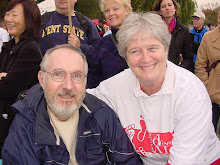
I would like to share with you some of the ways in which I have dealt with the milestones in this disease. My philosophy was to prepare myself in the best way possible for each succeeding stage. Does this make me a micro-manager? Borderline OCD? Yes I guess so. It’s probably partly genetic and partly because I worked for a guy who didn’t like surprises.
1. Before I fell hard enough to break something, I "graduated" from walking to a walker and then to a wheelchair.
2. Before transfers because difficult and risky I chose to use an Easy Pivot device (http://www.saratoga-intl.com).
3. To avoid the possibility of waiting too long, I got myself a feeding tube.
4. To avoid locked muscles, I had the baclofen pump implanted. My range of motion remains good.
5. In advance of a sharp decline in my breathing function, I got a BIPAP machine and use it at night. I am convinced that it has slowed down the deterioration of my breathing function.
6. Anticipating the decline of my speaking, I first purchased voice-recognition software allowing me to speak to my computer.
7. As the volume of my voice dropped, I got an amplification device, which makes speaking less tiring.
8. To get ready for the time that I would not be able to speak at all, I got a speech communication device that I can operate by headpointing.
9. I moved early to a condom catheter, which removed all of the stress dealing with that bodily function. I also prepared for the loss of bowel muscles by using a wonderful recipe I found online; a natural blend of fruits, which keeps things moving. I call this Tony’s TNT. (I'll post the recipe shortly)
10. To get ready for the point where accummulation of mucus and saliva would result in aspiration, I got a suction machine and a cough assist device.
11. To deal with pseudo bulbar I got a prescription for Zolof. Now I don’t cry at concerts anymore.
12. I enrolled in hospice while my breathing function was still fairly good because I strongly believe that the palliative care services they offer are a great comfort to ALS patients.
I believe that avoiding the rocks and shoals prolong your life expectancy. Do you agree or disagree? I'd like to hear from others.
Showing posts with label My View of ALS. Show all posts
Showing posts with label My View of ALS. Show all posts
Monday, December 17, 2007

Wednesday, December 12, 2007
"Fighting" ALS
In writings about cancer and many other diseases, there is talk about fighting because fighting is associated with the possibility of recovery (i.e. beating the disease). I think ALS is different. The literature on exercise for ALS patients is divided between those who believe active exercise can prolong life and those who believe that such exercise can accelerate muscle decay. For me the key is conserving strength. I’m not proud, I’m not stubborn, I’m quintessentially pragmatic. For example, I didn’t fight going into a wheelchair, I embraced it. My philosophy is that as PALS we should “navigate” through ALS, avoiding the rocks, shoals, and sandbars that mark our trip. The end point is the same, but getting there in the right way makes quality of life bearable and even extends life expectancy. We should leave fighting to the researchers. The problem is there are only 5,000 new cases every year. Until a marker is found for ALS, the big pharmaceutical companies won’t choose to spend money on treatments.
My View of ALS
All of us in the ALS community are coping with an enormously varied disease. No two cases fall in the same etiology, starting point, sequencing or stages, or rate of progression. The end result seems to be overwhelmingly uniform, i.e., a one way ticket to the happy hunting grounds. There is no cure. The many professionals we consult with can do little more than deal with symptoms that arrive as the disease relentlessly progresses and provide palliative care. What matters most, therefore, is the process of moving through this strange disease. There are lots of disguised “ blessings” stemming from ALS that make this disease unique. We generally retain all of our senses and our mental acuity, which means that our ability to experience the outside world is much more viable compared to those suffering from many other terminal diseases. We have time to put our affairs in order, repair damaged relationships and enjoy long goodbyes to loved ones and friends. We can still enjoy great literature, beautiful music, good food (at least for a while), and conversation. We can, with the assistance of amazing technologies, move about, use our computers, and enjoy relationships with loved ones and friends. The downside of these “blessings” is that we get to witness and experience in full technicolor and 3-D the gradual disintegration of all activities related to our voluntary motions. At some point, many of us will end up “locked in” and totally unable to communicate with the world.
Subscribe to:
Posts (Atom)